
Managing kudzu in the South is a little like managing CAD
The roots of the invasive vine go deep, as do the roots of my disease
Written by |

“Kudzu!”
A long time ago, my daughter and her friend, both GRITS — that is, girls raised in the South — giggled together in a classroom when they first heard about the invasive vine with the funny name. But I’m pretty sure everyone in the southern U.S. has dealt with kudzu.
Kudzu is a beautiful vine, with pretty purple flowers in the fall that smell similar to grape soda. It was imported to the U.S. during the Philadelphia Centennial Exposition in 1876. At first, it was just a novelty garden plant. Then, in the early 1900s, it was promoted as a shade vine for porches and as a forage crop for livestock. Beginning in the 1930s, the U.S. government promoted it for erosion control, and it was widely touted as having many positive uses.
The vine soon took over the South, and attitudes about it changed. Kudzu grows about 12 inches a day and is amazingly resilient. Driving home from church today, I counted at least seven areas covered by it, including at least one building where it was clinging to the wall, climbing onto the roof, and poking through some windows. It’s even on an empty lot in my neighborhood. The concern now isn’t erosion; it is how to control kudzu before it eats us.

Controlling both CAD and kudzu
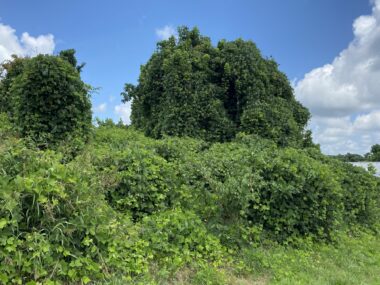
Kudzu covers everything but the sky along this street in Opelika, Alabama, making it impossible to see the bushes and trees. The vine, which can grow a foot a day, is capable of covering everything in its path. (Photo by Mary Lott)
Controlling kudzu is very much like trying to control cold agglutinin disease (CAD), an autoimmune, hemolytic anemia triggered by cold temperatures that causes the immune system to destroy red blood cells.
Because I have a low red blood cell count, none of my organs or cells receive sufficient oxygen to function optimally. Such is the insidious nature of CAD. Like kudzu in the South, CAD’s effects are felt everywhere.
Kudzu has an amazingly deep root system. Each of the patches I saw today had a single sustaining root system. Each root crown forms one connected organism linked by underground runners. The plant shares carbon, water, and energy, making it difficult to eradicate or even control.
CAD is very much like kudzu’s roots. I have a persistent cough because I’m not breathing in enough oxygen. I have brain fog because my brain doesn’t receive sufficient oxygen for the synapses to fully connect. My joints and muscles take turns screaming for more oxygen. The roots of CAD reach far and wide, just like the roots of kudzu.
Managing either kudzu or CAD requires determination and significant resources. I have learned not to ignore minor infections since last January, when a cold became sepsis in a matter of hours. This morning, my husband asked if I thought I needed my sweater before entering the sanctuary, which is set at a dangerous — for me — 69 F.
For both CAD and kudzu, there is no easy eradication, and whenever I see trees and berms covered with kudzu, I think at times, just as the farmers might, that the enemy is gaining ground. At present, various attempts are underway to control it before it overwhelms landscapes and buildings. Farmers have used bush hogs to mow the stuff down, only to repeat the process every six weeks throughout the long growing season. Meanwhile, herbicides have made inroads, and it’s become popular to let goats graze on it. It seems to be effective.
There are no goats in my CAD treatment plan. My medical team has employed a chemical treatment, while I employ lifestyle management, but I think that CAD is like kudzu and it’s seeking to take over my life. I know new treatment options are emerging and may soon be available, but until then, just as farmers have learned to manage the kudzu that borders their fields, I am learning to manage my life to keep my CAD under control.
Note: Cold Agglutinin Disease News is strictly a news and information website about the disease. It does not provide medical advice, diagnosis, or treatment. This content is not intended to be a substitute for professional medical advice, diagnosis, or treatment. Always seek the advice of your physician or other qualified health provider with any questions you may have regarding a medical condition. Never disregard professional medical advice or delay in seeking it because of something you have read on this website. The opinions expressed in this column are not those of Cold Agglutinin Disease News or its parent company, Bionews, and are intended to spark discussion about issues pertaining to cold agglutinin disease.

Leave a comment
Fill in the required fields to post. Your email address will not be published.