
Stem cell transplant leads to lasting remission of secondary CAD
Case report: Treatment completely normalizes self-reactive antibodies
Written by |
A stem cell transplant led to lasting remission of cold agglutinin disease (CAD) secondary to an aggressive lymphoma in a 48-year-old woman, according to a case report from Japan.
This was only the second reported CAD case in which levels of disease-causing self-reactive antibodies completely normalized after a stem cell transplant, according to researchers.
The case study, “Sustained molecular clearance of the MYD88 p.L265P-mutant clone preceding resolution of cold agglutinin syndrome after autologous stem cell transplantation,” was published in the journal Haematologica.

Stem cell transplant remains challenging in CAD, CAS patients
CAD is a rare autoimmune disease marked by self-reactive antibodies, called cold agglutinins, that attach to red blood cells at low temperatures, causing the cells to clump together and break apart in a process called hemolysis. This can result in anemia (low red blood cell counts), yellowing of the skin and eyes (jaundice), and fatigue, among other symptoms.
The disease can occur on its own or secondary to other conditions, most often an infection or a cancer involving antibody-producing B-cells, such as lymphoma. Secondary CAD is also known as cold agglutinin syndrome, or CAS.
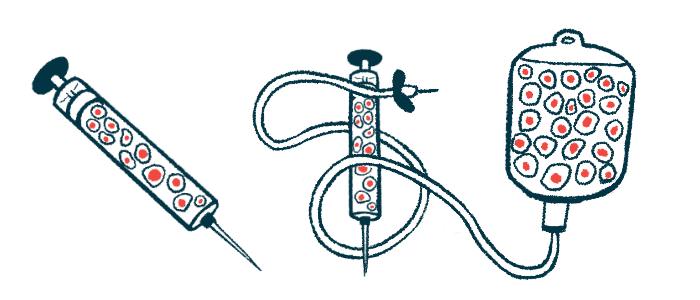
An autologous stem cell transplant (ASCT), commonly used to treat blood cancers, involves the collection of healthy hematopoietic stem cells, which can give rise to all types of blood cells, from a patient. After chemotherapy or radiotherapy, the cells are infused back into the patient to replenish the body with new healthy blood cells.
However, because the procedure involves many steps at lower than body temperatures, conducting it in people with CAD or CAS remains challenging, as it can result in red blood cell clumping and hemolysis.
At the time of the study, only five cases of ASCT in people with CAD or CAS had been reported, and cold agglutinin levels had normalized completely in just one. It therefore remains unclear whether ASCT can lead to lasting CAS remission and how such a response might occur.

Woman remained in complete remission from both DLBCL and CAS
In this report, physicians in Japan described the case of a 48-year-old woman with CAS due to a lymphoma who was successfully treated with an ASCT.
The woman first sought medical care in October 2015 after presenting with severe anemia, jaundice, and a markedly enlarged spleen. Blood tests showed signs of hemolysis, high levels of cold agglutinins, and the presence of antibodies or other immune proteins bound to red blood cells, all of which are suggestive of CAD.
Her spleen was removed and its analysis confirmed the presence of splenic marginal zone lymphoma, a slow-growing B-cell cancer that mainly affects the spleen. Genetic analysis of cells in spleen and bone marrow identified a mutation in the MYD88 gene, called p.L265P, that is associated with the development of certain types of lymphoma.
The mutation was also found in circulating tumor DNA (ctDNA), small fragments of cancer-derived genetic material released into the bloodstream. These findings supported a diagnosis of lymphoma-associated CAS.
Spleen removal eased hemolysis and reduced the proportion of ctDNA carrying the p.L265P mutation from 3.2% to 1%, although cold agglutinin levels remained high.
The woman received eight cycles of rituximab, a therapy sold under the brand name Rituxan and others that targets B-cells and is commonly used off-label in CAD. This further reduced the amount of mutated cancer cells in the bone marrow, but her cold agglutinin levels remained elevated.
In August 2021, the amount of mutated ctDNA rose to 7.6%. This increase was detected three months before the woman’s cancer progressed to diffuse large B-cell lymphoma (DLBCL), a more aggressive B-cell cancer.
Overall, this case provides molecular evidence that durable remission of CAS is achievable post-ASCT.
After four cycles of chemotherapy, imaging showed a complete metabolic response, meaning no active cancer was detected, and mutated ctDNA was no longer detected.
Because of her age and the lymphoma’s response to chemotherapy, doctors planned an ASCT as consolidation treatment to reduce the risk of DLBCL returning. Doctors collected enough stem cells over two days without complications, using a blood warmer during the procedure.
However, severe cell clumping occurred within minutes of infusing the thawed stem cells, repeatedly blocking the filter and requiring 10 circuit changes over two hours. The woman had a temporary drop in blood oxygen levels but no serious complications, and the full stem cell dose was successfully infused.
In term of blood cells, infection-fighting neutrophils recovered by day 10 after the transplant, and platelets (fragments involved in blood clotting) recovered by day 17. Cold agglutinin levels reached the normal range 14 months (a little over a year) after the procedure, which was maintained for more than 30 months (about 2.5 years).
The MYD88 mutation also remained undetectable in ctDNA, indicating sustained molecular remission. At the most recent follow-up, the woman remained in complete remission from both DLBCL and CAS.
“Overall, this case provides molecular evidence that durable remission of CAS is achievable post-ASCT,” the researchers wrote.
While high cold agglutinin levels should not necessarily prevent eligible patients from undergoing an ASCT, careful temperature control and preparation for infusion-related cell clumping are essential, they concluded.




Leave a comment
Fill in the required fields to post. Your email address will not be published.