
Being vigilant during transfusions brings me a vital victory
Low hemoglobin levels send me back to the hospital for 4 more transfusions
Written by |





I expected to be feeling better and to have more energy after I received two units of red blood cells (RBCs) earlier this month, but instead, 10 days later, I found myself at the Spencer Cancer Center, feeling much worse.
It was no wonder, a triage nurse said after my blood was tested. My hemoglobin level was down to 4.6 grams per deciliter (g/dL), way below the normal range for women of 11.6-15 g/dL. I was admitted to the hospital to receive additional units of RBCs.
But why did my hemoglobin level drop so low after just receiving blood? It was 7.6 g/dL just before I received more blood this month. The numbers should have gone up, not down. What went wrong? The answer seemed to lie with the blood handling.

Getting warmer
Cold agglutinin disease (CAD) is caused by self-reactive antibodies on the surface of RBCs that cause them to clump together at cold temperatures, targeting them for destruction in a process called hemolysis.
After discussing it with my medical team, I came to suspect that the blood I received on Feb. 7 was not sufficiently warmed. I remember seeing the blood warmer set to 41 C (105.8 F), but the blood in the tubing lying on my arm was quite cold. Apparently, it began hemolyzing as soon as it entered my body, and that continued throughout the week.
With the problem identified, it became very important to be vigilant so recent history didn’t repeat itself. Getting that new blood would take a long time, however. I’d been admitted around 3 p.m., but by 9 p.m., no transfusions had begun yet.
Being rare means being patient
Because I have CAD, I needed special antibodies. These are brought from an out-of-town blood bank on an as-needed basis. Four units were ordered so I had to be patient.
After two units arrived, I watched as the blood warmer was set up, primed, and saline was sent through the machine to check if it was properly warmed. Priming is an important step.
The first unit began. It was transfused slowly and my vitals were checked every five minutes, then every hour. Each unit took between three and four hours to be fully transfused. An hour later, my blood levels were checked before the next unit was started, an agonizingly slow process. The third unit didn’t finish until many hours later.
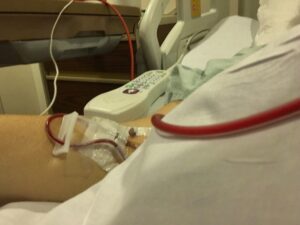
photo by Mary Lott
Mary Lott receives the first of four units of packed red blood cells. (Photo by Mary Lott)
But everyone was excited when my hemoglobin levels read 7.2 g/dL. Things were moving in the right direction. Still, it was believed that I would benefit from a fourth unit.
The hospital shift change was at 7 p.m. When the transfusion hadn’t started by 6 p.m., I knew we were in for a late night. At 9 p.m., I was discouraged and tired and tried to get some sleep.
Finally, around 10 p.m., the nurse in charge of my care told me the blood had just arrived and the next transfusion would begin soon. She began working with the blood warmer, but the saline didn’t feel warm to me. I said I wasn’t comfortable with the temperature, and a new blood warmer was found and set up.
The fourth transfusion finished up around 3 a.m. Friday, but I was tired and forgot to remind the nurse to keep the vials warm when my blood was taken later for a hemoglobin check. The result was a distinctly lower 6.7 g/dL. After I realized what had happened, a second hemoglobin check showed it at 8.2 g/dL.
I was able to go home that night. Being vigilant about my healthcare paid off.
Note: Cold Agglutinin Disease News is strictly a news and information website about the disease. It does not provide medical advice, diagnosis, or treatment. This content is not intended to be a substitute for professional medical advice, diagnosis, or treatment. Always seek the advice of your physician or other qualified health provider with any questions you may have regarding a medical condition. Never disregard professional medical advice or delay in seeking it because of something you have read on this website. The opinions expressed in this column are not those of Cold Agglutinin Disease News or its parent company, Bionews, and are intended to spark discussion about issues pertaining to cold agglutinin disease.



Sharon Mowry
Thank you for this is excellent information I did not know about the tubing to be warm.
How do they warm the tubing ?
Just asking as the hospital knows nothing about CAD.
Nancy
Mary, you’ve been through so much. God bless you! Stay warm and rest my fellow CAD sufferer.