
Making a pattern in needlework prepared me for my CAD diagnosis
Like the first set of double stitches, my blood cell counts told me something was up
Written by |





Attending elementary school from 8 a.m. to 3 p.m., Monday through Friday, was just the basis of my education. At age 5, I began doing needlepoint and other forms of needlework.
Among these was lace-making in the form of tatting. I was not very good at it, nor at crochet or knitting, for that matter. My interest was in being outside — climbing trees, tramping through the woods, or playing sandlot football with the neighborhood kids. Still, since my taskmasters were my mother and grandmother, I mastered the needle arts, as well.

The basics of tatting
Tatting, by all appearances, is simple. It requires a thread manipulated into a series of loops using a small shuttle, or by a long needle. These loops are interlocked to form lace doilies, pretty collars, hem trims, and insertions into blouses. Tatted baby bonnets and booties are often gifted to new mothers. Not only does tatting require fine thread and skillfully moving tatting shuttles, but it also takes patience.
Every piece of tatting work starts in the same way. A needle or shuttle is held in one hand. The thread stretches from that hand to the other in such a way that it can be looped onto the needle to form a half-hitch knot. Then, the needle is inserted into the thread on the holding hand, the thread is looped in the opposite direction, and the needle is brought out to form a second, half-hitch knot, with the two knots facing each other.
The tatter continues making a prescribed number of these double stitches, even though it’s impossible to see what the final outcome will be at this point.
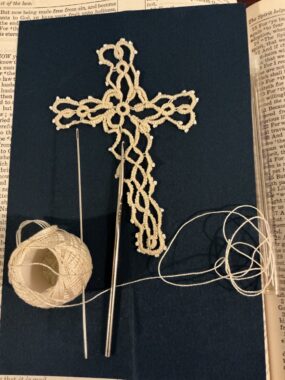
A cross-shaped bookmark is made through a type of needlework called tatting. (Photo by Mary Lott)
Comparisons to CAD
Cold agglutinin disease (CAD) began in such a fashion with me. My husband and I first noticed high white blood cell counts and low red blood cell counts when I had my blood checked for malaria. Like the initial set of double stitches in tatting, we could tell something was happening. We just couldn’t discern what it was yet.
The tatter, at some point, will leave a space between the double stitches. On the other side of the space, the tatter will continue making double stitches, eventually reaching the end of the pattern for the first loop. Then the tatter will slide all the stitches off the needle and pull it closed, making a loop. Things are just beginning to take shape.
This is how I felt when I went to Singapore in 2016 to investigate my many symptoms. I was looking for a doctor to pull it all together into a cohesive loop. The diagnosis was not complete yet, but I realized that a disease was close to recognition.
In tatting, it is not enough to have a series of loops made from half-hitches. The real beauty of a piece happens when the spaces — now called picots — are joined together, and the actual pattern develops.
Here, the comparison to CAD breaks down, because CAD isn’t beautiful or joyful when all its pieces come together. Still, it is a relief to have a name for it. I know that when my finger turns bright white, I must get it warmed up immediately because I’m experiencing something called Raynaud’s phenomenon. I know the fatigue I experience as I brush my teeth is due to anemia.
Dealing with CAD requires attention to detail, much like working on a tatting piece. I need to pay attention to whether I’m hemolyzing in the same way I have to pay attention to the number of half-stitches I’ve made and to where I’m at in the pattern.
Today is International Tatting Day. Many of us who tat use the day to show works in progress, swap patterns, or plan our next one. Little did I know that the discipline, patience, and attention to detail that I was forced to learn then would be utilized in dealing with CAD.
Note: Cold Agglutinin Disease News is strictly a news and information website about the disease. It does not provide medical advice, diagnosis, or treatment. This content is not intended to be a substitute for professional medical advice, diagnosis, or treatment. Always seek the advice of your physician or other qualified health provider with any questions you may have regarding a medical condition. Never disregard professional medical advice or delay in seeking it because of something you have read on this website. The opinions expressed in this column are not those of Cold Agglutinin Disease News or its parent company, Bionews, and are intended to spark discussion about issues pertaining to cold agglutinin disease.

Leave a comment
Fill in the required fields to post. Your email address will not be published.